Why CRMs Fail Relationship-Driven Businesses
Sam Okpara
November 2025
Most relationship-driven businesses do not lose revenue because they forgot to buy a CRM.
They lose revenue because important conversations go quiet.
A warm intro sits untouched for nine days. A follow-up promised after a meeting never gets sent. Someone asks for a proposal, then hears nothing until the moment has gone cold. None of that looks dramatic in a dashboard. It just quietly compounds.
The numbers behind that problem are hard to ignore. In HubSpot's 2024 Sales Trends Report, 72% of company revenue came from existing customers, and 82% of sales pros said building relationships is the most important part of selling. Meanwhile, LinkedIn's 2024 Sales Leader Compass found that teams spend an average of 2.5 hours researching each buyer and their business before every meeting.
That means the revenue-critical work is not data entry. It is attention, context, and follow-through.
What traditional CRMs do well, and where they stop
CRMs are good at storing records.
They track contacts, log activity, maintain pipeline stages, and produce reports. For a lot of businesses, that is useful enough.
But relationship-driven teams usually need more than storage. They need help answering questions like:
- Who needs attention today?
- Which thread is cooling off?
- What did I promise this person last time?
- What should I send next?
- Which relationship is getting neglected because nothing is technically overdue yet?
Traditional CRMs rarely answer those questions well. They keep the history, but they do not do much with it.
That is the gap Relate was built to close.
The actual problem is not memory, it is synthesis
People assume relationship management breaks because teams forget things.
That is only half true. The harder problem is that the context lives everywhere: email threads, meeting notes, calendar history, CRM records, informal commitments, and personal details that matter in relationship-based work.
A sales leader, advisor, consultant, or agency principal does not need another database as much as they need a system that can synthesize context across those surfaces and turn it into a useful next action.
What relationship intelligence needs to do
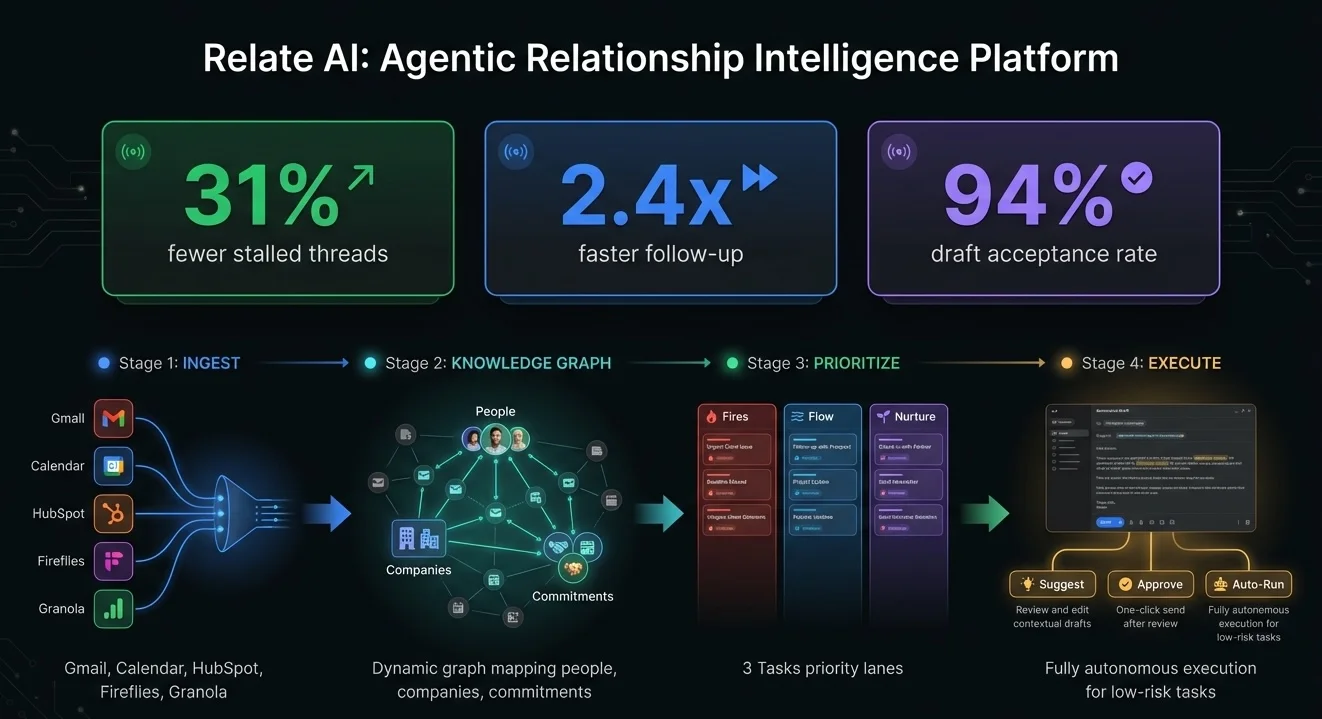
We designed Relate around four layers.
1. Ingest the real communication streams
Relate connects to the channels where relationship context already lives, including Gmail and Outlook, Google Calendar, HubSpot where it already exists, and meeting transcript tools like Fireflies and Granola.
The point is not to force more manual logging. It is to work from the signals the team is already creating.
2. Build a usable knowledge graph
A contact record is not enough.
The system needs to understand the web of people, companies, meetings, commitments, topics, and historical context around each relationship. That includes practical details like role, deal stage, and interaction frequency, but also softer signals: what was promised, what changed in tone, which topics keep recurring, and who else is connected to the conversation.
That is where a lot of CRMs feel flat. They capture facts. They do not build context.
3. Prioritize attention deterministically
This part matters more than most teams expect.
If a system only stores context, the user still has to decide where to look. Relate scores and prioritizes relationships based on recency, commitments, cadence, and risk signals so the user starts the day with an ordered view of what needs attention.
We break that into practical lanes: a needs-attention-now lane for overdue commitments, stalled threads, and at-risk relationships, an active-flow lane for conversations moving at the right pace, and a nurture lane for valuable relationships that are quiet but should not disappear.
That routing is intentionally grounded in clear logic, not vague "AI intuition."
4. Draft the next move with guardrails
Once the system knows what needs attention, it should reduce the time-to-action.
Relate drafts the next move based on the actual thread and context. That might be a follow-up email, meeting prep notes, a reminder about an open commitment, or a suggested outreach tied to the relationship history.
But the user still controls the boundary. We designed for different levels of autonomy: suggest only, draft and require approval, or auto-run a narrow set of low-risk updates.
That matters because relationship work is high-context work. The value is not in removing the human. The value is in making the human faster and better prepared.
Why this matters financially
For relationship-driven businesses, neglected follow-up is slow-motion revenue leakage.
That is true for consultants, agency leaders, wealth advisors, investors, executive recruiters, and anyone whose business depends on a smaller set of deeper relationships rather than a high-volume transactional pipeline.
In early internal and pilot usage, we saw a few patterns quickly: fewer stalled conversations, faster follow-up after meetings, and high acceptance rates on drafted responses because the context was already there.
Those are not vanity metrics. They are proxies for whether the system is actually reducing the gap between intent and action.
Who this is for
Relate is not for every sales motion.
If the team runs a classic high-volume outbound engine with heavy sequencing, strict SDR workflows, and a pipeline built around large top-of-funnel volume, a traditional CRM and sales engagement stack may still be the better core system.
Relate is better suited to businesses where relationships are fewer, deeper, and higher value, context matters more than raw lead volume, follow-up quality affects revenue materially, and people are carrying too much relationship state in their heads.
That is a very different operating environment from a standard transactional pipeline.
What changes when the system tracks attention instead of records
This is the bigger shift.
CRMs were built for a world where the hard part was storing information. For a lot of modern relationship work, storage is the easy part. The hard part is deciding what matters now and acting on it before the moment passes.
That is why we think the next generation of relationship software has to do more than record history. It has to help teams work the relationship while there is still something to save, close, or grow.
The bottom line
Traditional CRMs are not broken because they fail to save data. They are broken for relationship-driven teams because they stop one step too early.
They tell you what happened. They are much worse at helping you decide what to do next.
Relate is our answer to that gap: a system that ingests communication signals, turns them into usable context, ranks attention, and helps draft the next move without taking control away from the user.
If your business depends on follow-through, context, and timing, that is a much more important problem than another place to log notes.
If that sounds familiar, Relate is the product version of the idea, and our AI & Intelligent Automation work is where we build systems like this for clients.
Need help building something like this?
At Paramint, we build production AI systems, custom software, and internal tools for growth-stage startups, enterprises, and government agencies. We focus on solutions that deliver measurable impact, not just demos.
Get in touchProduct
Building ReviewMyHinge: Lessons From a Two-Sided Marketplace
What building a dating profile review marketplace taught us about cold starts, trust design, pricing, repeat usage, and two-sided product operations.
Product
AI RFP Response Automation: Building Vercor
Why proposal teams still lose days to RFP assembly work, and how we built an AI pipeline for extraction, drafting, staffing, formatting, and compliance review.